





"The Time Machine" is a true jewel of literature and a masterwork signed by H.G. Wells. This story is one of the most notable to have influenced and defined the science-fiction genre. But before diving into the pages of this classic novel, let's take a moment to better understand its author and the details of this tale.
The Author — H.G. Wells
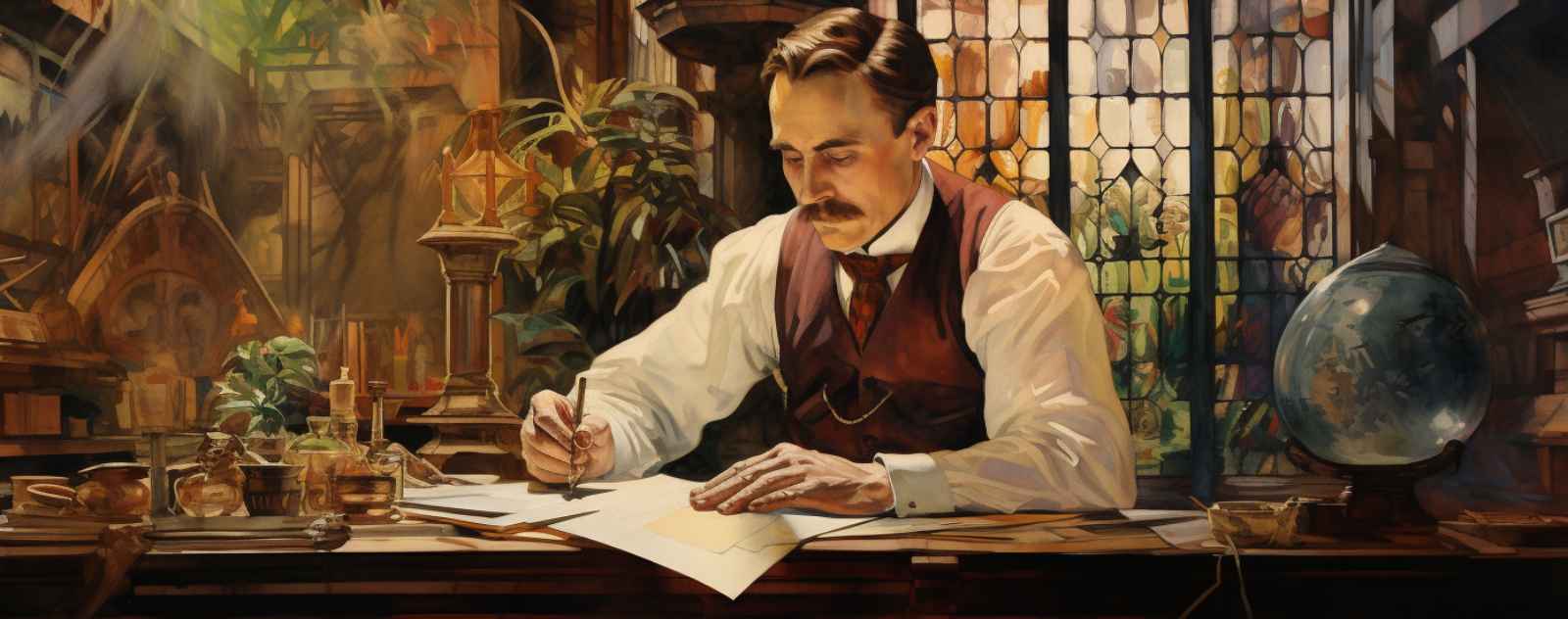
Herbert George Wells, often abbreviated to "H.G.", is without question one of the founding pillars of science fiction. With a profound mastery of his craft, he dared to present revolutionary concepts and thus laid the solid foundations of the genre. Beyond "The Time Machine" and "The Invisible Man", he plunged readers into a memorable alien invasion with "The War of the Worlds". These adventures underscore the idea that, while science is a precious tool for humanity, it can also be our undoing if misused.
Wells' Impact on Science Fiction
Wells, with his gift for storytelling, did not merely recount stories — he brought events and universes to life. His novels, imbued with a socio-critical dimension, tackled the contemporary issues of his era. In "The Time Machine," for example, the traveler's encounters with the Eloi and the Morlocks serve to depict the failings of social division, and to illuminate the potentially devastating consequences of such segregation.
The Main Themes of The Time Machine

H.G. Wells' novel is rich with themes that are diverse and wide-ranging. The machine, at the center of the story, is far more than a simple means of traveling through time. It is a tool of exploration, allowing the traveler to confront uncomfortable truths and potentially dark visions of the future. The journey across eras, the evolution of humanity, and above all the ethical implications of such a discovery are all subjects addressed.
-
Social Class: Wells was an avowed socialist, and this is clearly reflected in his novels. In "The Time Machine," the division between the Eloi and the Morlocks represents social class segregation. The Eloi, who live in decadent leisure on the surface, symbolize the upper class, while the Morlocks, who toil endlessly in the underground darkness, represent the working class. Wells thus critiques social and economic inequality, showing that wealth and poverty can lead to an evolutionary divergence of the human species.
-
Human Evolution: As a futurist, Wells was fascinated by the concept of human evolution. He explored this theme in many novels, but it is in "The Time Machine" that it is most evident. Wells raises the question of what humanity would become if divided into two distinct species by class divisions, suggesting that our social and biological evolution are intrinsically linked.
-
Scientific Ethics: Finally, Wells frequently explored scientific ethics in his works. In "The Time Machine," the time traveler must face the unforeseen consequences of his discovery. It is a warning against the reckless pursuit of scientific progress without regard for its potential consequences on society and humanity at large.
Summary of The Time Machine

The Protagonist and His Invention
H.G. Wells' "The Time Machine" is the fascinating story of an anonymous inventor, simply referred to as the "Time Traveller." This bold and forward-thinking protagonist creates an incredible machine capable of traversing dimensions — including time itself.
The intrepid traveler, the central character of the story, shows extraordinary courage by daring to propel himself into the future using his machine. In the course of his adventures, he encounters two descendants of humanity: the Eloi and the Morlocks. His journey, rich in lessons, allows him to understand the possible pitfalls of our current society.
Who Is Alexander Hartdegen?
Alexander Hartdegen is a fictional character from the 2002 film "The Time Machine." In this adaptation of H.G. Wells' novel, Hartdegen is an inventor and scientist from New York — as opposed to London in the original novel — during the Victorian era who, following a personal tragedy, creates a time machine with the goal of changing the past. This character is a variation on the anonymous "Time Traveller" of the original novel. He is played by actor Guy Pearce.
The Journey Through Time

The journey through time, as described by H.G. Wells, is a fascinating epic that transcends the limits of human knowledge and understanding. The idea of crossing eras, of plunging into unknown temporal dimensions, is an adventure that inspires both curiosity and apprehension.
This contrast highlights the way in which technology, when used without control or foresight, can reshape society. The traveler, through the eyes of a man from the late 19th century, observes this world with astonishment and sometimes horror. He realizes that the machine, beyond being a tool of exploration, is also a mirror reflecting the flaws of his own society.
The narrative, rich in detail and events, shows that the journey through time is not merely a quest for adventure, but also a profound inquiry into human nature — its ambitions, its mistakes, and its courage. Every encounter, every discovery serves as a reminder that time, though intangible, has a powerful impact on everything and everyone.
The journey through time is a powerful means of confronting humanity with its own errors and its potential. It is a warning about the dangers of group division and technological dependency, but also a celebration of humanity's capacity to adapt, learn, and evolve.
The Eloi and the Morlocks

In the course of his temporal adventures, the Time Traveller encounters two distinct races among humanity's descendants: the Eloi and the Morlocks. The Eloi are gentle and apathetic, living in a surface paradise. They spend their lives in decadent leisure, as the degenerated descendants of the upper class, having lost all knowledge, ambition, curiosity, and will to learn or work.
The Morlocks, by contrast, are terrifying — a group dwelling in the dark depths of the earth. They are the descendants of the working class, condemned to live in darkness and to maintain the machines that sustain the Eloi's lifestyle. The Morlocks have become nocturnal creatures who emerge at night to hunt careless Eloi.
These two races offer a scathing critique of class division in Victorian society, showing the devastating consequences of allowing one class to oppress another. In this distant future, the Time Traveller witnesses a dark warning of what could happen to humankind if society continues on its current path.
Influence on Popular Culture

H.G. Wells' "The Time Machine" has left a deep and pervasive mark on popular culture. This iconic novel is not only a literary masterpiece, but it has also shaped and influenced the way we perceive and envision time travel in contemporary culture, redefining the science-fiction genre.
Time Travel: A Pillar of Science Fiction
Although time travel has its roots in ancient folklore and myths, it was Wells who propelled it to the forefront of modern literature. With his captivating narrative and imaginative vision, he established time travel as a central element of science fiction. From the iconic TV series "Doctor Who" to the cinematic adventures of "Back to the Future," the echoes of Wells' genius resound across the decades. His unique treatment of this concept opened unexplored avenues, allowing authors and filmmakers to play with the idea of moving through temporal dimensions.

Steampunk Uchronia: a journey outside of time
The Time Machine and Steampunk
Steampunk is a science-fiction subgenre characterized by its Victorian influences, steam-powered machinery, and retro-futuristic technology. Although H.G. Wells' "The Time Machine" was published before the term "steampunk" came into use, Wells' work — and this novel in particular — undeniably influenced and prefigured many elements of the genre.

-
Aesthetic Influence: Wells' description of the time machine evokes the steampunk aesthetic. Made of bronze, ebony, and quartz crystal, with its leather seat, the machine itself is a wonder of Victorian engineering, blending ancient craftsmanship with cutting-edge technology. In steampunk, this fusion of old and new is common, where steam-powered machines coexist with futuristic devices.
-
The Contrast Between Technology and Society: Another major steampunk element is the contrast between advanced technology and a society that remains deeply rooted in Victorian values. In "The Time Machine," Wells explores the class divisions of the Victorian era and their potential consequences. Steampunk, with its airships commanded by top-hat-wearing captains and inventors in tailcoats, also plunges into this juxtaposition between futuristic technology and an older aesthetic.
-
Critique of Modernity: Many steampunk works express a certain nostalgia for an era when technology was tangible and comprehensible, while also critiquing the restrictive aspects of the Victorian age. Wells' "The Time Machine," while serving as a warning about the dangers of unregulated progress, also captures this spirit. The Time Traveller, despite his incredible invention, remains anchored in the sensibilities of his own era.
Impact on Literature and the Seventh Art
Beyond the concept of time travel, "The Time Machine" has served as a springboard for numerous film and literary adaptations. Filmmakers have been drawn to the richness of the story, bringing it to the screen on multiple occasions — the 2002 adaptation being only one of many interpretations of the novel. Furthermore, science-fiction writers worldwide, charmed and inspired by Wells' vision, have revisited and reimagined his themes, integrating his ideas into their own narratives, testifying to the lasting and universal influence of his work.
Reflections on the Future
Perhaps the most striking and powerful element of "The Time Machine" lies in its ability to challenge us regarding our future in light of the decisions we make today. Through his narrative, Wells transports us into a dark, almost nightmarish future vision, marked by exacerbated social divisions and a dehumanizing technological dependency. It is a poignant illustration of what our society could become if we fail to exercise caution and discernment.
At the heart of his narrative is a warning against inaction and indifference. It underscores the importance of recognizing that every action, every mistake, and every choice has consequences that can extend far beyond our own era. The dystopian future described by Wells is not simply fiction designed to entertain, but a call to vigilance, reminding us of our duty to actively engage in building a brighter and more equitable future.

Thus, "The Time Machine" remains more than a simple novel — it is a mirror in which we can observe potential reflections of our future. Wells issues us a challenge: not to content ourselves with dreaming of a better future, but to work with determination and conscience to make it a reality.
FAQs
-
Who is the author of "The Time Machine"? H.G. Wells is the author of "The Time Machine."
-
When was "The Time Machine" published? "The Time Machine" was first published in 1895.
-
What are the main themes of "The Time Machine"? The main themes of "The Time Machine" are social inequality, human evolution, and scientific ethics.
-
Who are the Eloi and the Morlocks in "The Time Machine"? The Eloi are a gentle and apathetic surface race, while the Morlocks are a terrifying, nocturnal underground race.
-
Has "The Time Machine" been adapted for the screen? Yes, "The Time Machine" has been adapted several times, most notably in a 1960 film and a 2002 BBC mini-series.