





The world of Cyberpunk is rich, complex, and steeped in mystery. It combines science fiction, futurism, and a sometimes dark vision of our society. But what exactly is Cyberpunk Style? What are its core themes? How does it manifest in literature, cinema, television, and video games? This article offers a penetrating look into this fascinating universe.
We won't focus solely on the Cyberpunk 2020 tabletop RPG from which CD Projekt Red's video game was born, but on the movement as a whole. Each section too dense to cover fully here will have its own dedicated article.
A Clear Look at Cyberpunk

Definition of Cyberpunk
The term "Cyberpunk" is widely used but often misunderstood. At its core, Cyberpunk is a subgenre of science fiction that combines cutting-edge technology with a dystopian atmosphere. The term itself is a blend of "cybernetics" and "punk," illustrating a collision between high technology and rebellious counter-culture.
Origins of Cyberpunk
The origins of Cyberpunk trace back to the 1980s, and author William Gibson is often credited as one of its pioneers. His short story "Johnny Mnemonic" and his novel "Neuromancer" laid the foundations of the aesthetic and themes, where characters navigate a world saturated by technology while struggling against oppressive power structures. The word itself was popularized by Bruce Bethke's novel, "Cyberpunk," published in 1983.
Historical Context of Punk Uchronias
The emergence of Cyberpunk cannot be separated from its historical and cultural context. During the 1980s, the world was beginning to feel the effects of globalization and the information age, where digital technologies were rapidly transforming society. Concerns about the effects of this rapid transformation were widespread, and the genre was born from these anxieties.
At the same time, the punk movement was gaining popularity, bringing with it an attitude of defiance toward authority and a critique of consumer society. These punk sensibilities were reflected in Cyberpunk, with its stories of marginalized characters defying powerful corporations and oppressive governments in technologically advanced urban environments.
The Progression of Cyberpunk: The Flesh Is Weak
The emergence of Cyberpunk was also influenced by academic theories of the time, particularly postmodernism. With its focus on subjectivity, deconstruction, and genre blending, postmodernism provided a key theoretical framework for writers.
In short, Cyber is the product of a particular era, reflecting the concerns, fears, and hopes of a society grappling with rapid change and growing uncertainty about the future.
The Core Themes of Cyberpunk

Technology and the Human Being
The interaction between technology and the human being is one of the pillars of Cyberpunk. This manifests in several ways, most notably through human-machine fusion and artificial intelligence (AI).
Human-Machine Fusion
Human-machine fusion is a recurring theme in Cyberpunk. Characters are often depicted with cybernetic enhancements and prosthetics, neural implants, or even entirely artificial bodies. These legendary upgrades can offer superhuman abilities, but they also raise questions about identity, humanity, and control over one's own body.
AI and Consciousness
AI is another essential theme of Cyberpunk. AI characters can be allies, enemies, or something in between. Authors frequently explore the implications of AI, including whether a machine can possess consciousness and what that means for our understanding of consciousness itself.
Dystopia and the Future Society
The setting of Cyberpunk is generally a dateless (perhaps 2077) dystopian future society where powerful corporations dominate and social inequality is extreme. Cities like the famous Night City are often depicted as futuristic urban jungles, dominated by neon skyscrapers and labyrinthine slums.
Corporations and Social Inequality
Cyberpunk often presents futures where corporations wield more power than governments — the mega-corporations. Social inequalities are exacerbated, with a wealthy elite and a vast mass of poor people. These themes reflect concerns about hyper-capitalism, privatization, and social injustice. Essentially, imagine the tech giants merging until they control entire countries.
The Cyberpunk City: Neon and Darkness
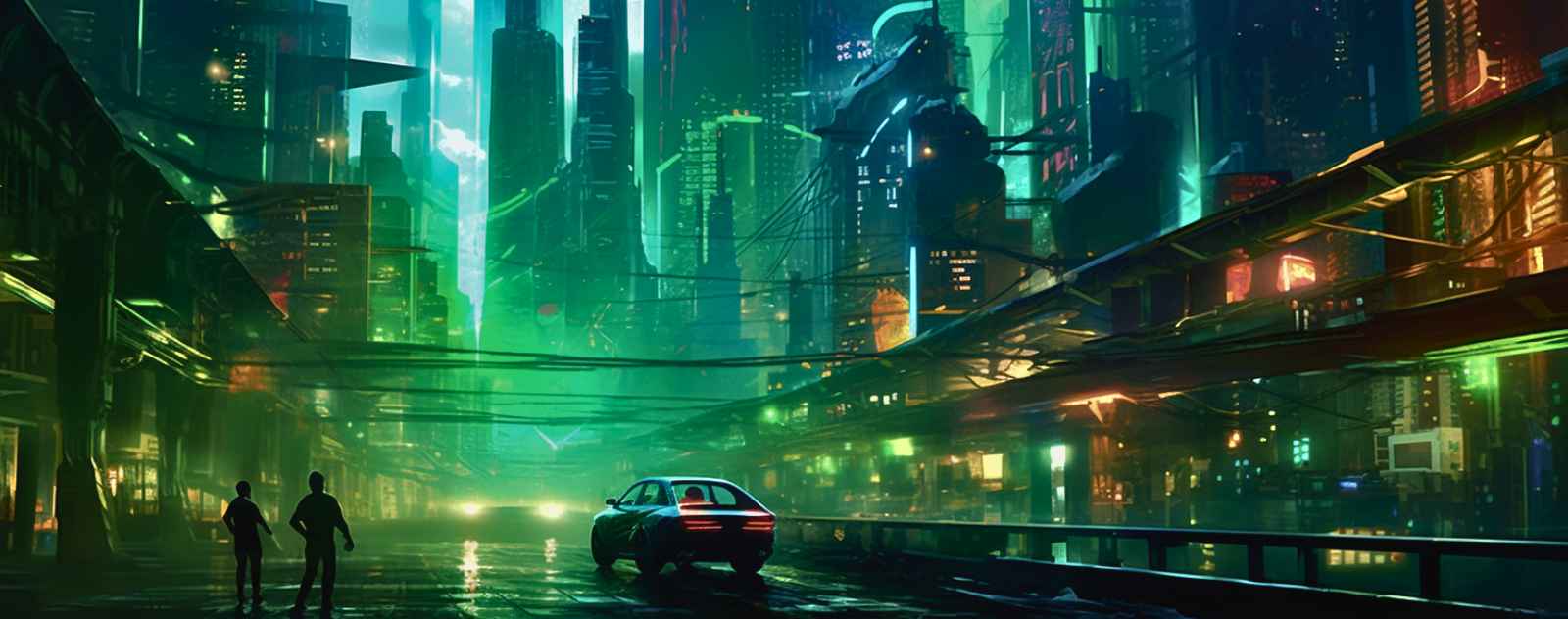
The megacity is characterized by its neon-noir aesthetic, fusing high-tech glamour with urban decay. These cities are often depicted as overcrowded, polluted, and dominated by technology. This urban backdrop serves as the canvas for stories of struggle and survival in an inhuman world.
Cyberpunk in Literature

The Pioneers: Gibson, Sterling, and Others
Cyberpunk literature was shaped by a number of pioneering authors whose work defined the genre. William Gibson is arguably the most influential among them, with his novel "Neuromancer" considered the genre's founding text. Bruce Sterling, another major author, co-wrote with Gibson the novel "The Difference Engine," which introduced the concept of steampunk.
Other notable authors for your reading list include Pat Cadigan with "Synners," an exploration of virtual reality and AI, and Rudy Rucker, whose novels such as "Software" tackled themes of transhumanism and the technological singularity.
Neuromancer
"Neuromancer" is often cited as the novel that defined Cyberpunk. The story follows Case, a hacker who is hired for a secret mission involving a powerful AI. The novel explores themes such as virtual reality, human-machine fusion, and artificial consciousness. Its influence on the genre is immense, from the "neon and darkness" aesthetic to the idea of the "matrix" as a metaphor for digital space.
Snow Crash — The Virtual Samurai
"Snow Crash" by Neal Stephenson is another major work of the genre. The book presents a future where corporations rule and cyberspace mingles with reality. Its protagonist, Hiro Protagonist, is a pizza delivery driver for the Mafia and a samurai of cyberspace. The novel is celebrated for its exploration of linguistics, mythology, and virtual reality.
The Influence and Evolution of Cyberpunk in Modern Literature
Cyberpunk style has had a profound influence on modern literature. It has inspired a range of sub-genres, from post-cyberpunk to biopunk, and has influenced authors across other genres. Its themes — from human-machine fusion to technological dystopia — are now ubiquitous in contemporary fiction.
Furthermore, the genre has also evolved to reflect new technological and social realities. Authors such as Cory Doctorow in "Little Brother" and Paolo Bacigalupi in "The Water Will Come" have used the cyber framework to explore the implications of digital surveillance, climate change, and environmental crisis.
Cyberpunk in Cinema and Television

Classic Cyberpunk Films
Cyber has also made its mark on the big screen, with films that captured the public's imagination and influenced countless other media.

The Best Cyberpunk Films You Must See
Blade Runner and Its Dark, Neo-Noir Vision
"Blade Runner" by Ridley Scott, based on the short story "Do Androids Dream of Electric Sheep?" by Philip K. Dick, is often cited as the genre's flagship film. With its neon-noir aesthetic and dystopian atmosphere, it created an influential vision of the future. The film also raises profound questions about humanity and identity through its exploration of "replicants" — synthetic beings indistinguishable from humans.
The Matrix and Virtual Reality
"The Matrix" by the Wachowskis revolutionized cinema with its blend of action, philosophy, and virtual reality. The film explores the idea of a world as a complete simulation, raising questions about the nature of reality and freedom. "The Matrix" also popularized Cyber and punk aesthetic elements, such as black leather costumes and round sunglasses.
Cyberpunk TV Series and Adaptations
Television has also embraced Cyberpunk, with innovative series and literary adaptations.
1. "Altered Carbon" and Digital Immortality
"Altered Carbon," based on the novel by Richard K. Morgan, presents a future where consciousness can be stored digitally and transferred between bodies. The series explores the implications of this "digital immortality," including inequality, dehumanization, and the loss of identity.
Ghost in the Shell: Anime and Transhumanist Philosophy
"Ghost in the Shell," an influential anime franchise, blends action, philosophy, and a distinctly Japanese cyber aesthetic. The content explores themes such as AI, human-machine fusion, and cybernetics through the story of Motoko Kusanagi, a cyborg working for a public security agency.
Night City in Video Games

Cyberpunk's Impact on Game Design
Cyber has profoundly influenced the world of video games, both in terms of aesthetics and gameplay. Games in the genre are often distinguished by their dark, dystopian atmosphere, their detailed urban environments where you can explore the city of the future, and their blend of advanced technology and social decay. In terms of gameplay, many games offer rich scenarios full of choices and consequences, reflecting the themes of freedom and rebellion against authority that are central to the genre.
Iconic Games of the Cyberpunk Genre
Deus Ex
"Deus Ex" is one of the most celebrated games of the genre on PC. The game combines RPG elements with first-person shooting, and offers players a high degree of freedom of choice. "Deus Ex" explores many Cyberpunk themes such as conspiracy, surveillance, and human-machine fusion, while offering sharp social commentary.
Cyberpunk 2077 and the Future Phantom Liberty, RPG by CD Projekt Red
"Cyberpunk 2077," notoriously unplayable at launch and widely known for its troubled development, was patched update after update. It is another important title in the video game landscape on PS4, PS5, and PC. Based on the Cyberpunk 2020 tabletop RPG, the game offers a vast and detailed open world set in Night City, memorable characters, and a multitude of gameplay choices — action and adventure are well balanced.
It tackles themes such as inequality, mega-corporations, and identity, while delivering an impressive visual representation of Night City.
Announcement: an expansion to CD Projekt Red's game called Phantom Liberty was planned and was to be presented at the Summer Game Fest in June 2023. Cyberpunk 2077 seems to be slowly winning back players' approval with this DLC, which appears to be of solid quality.
Cyberpunk in Music and Art

The Sounds of Cyber: Synthwave and Beyond
Music has played a key role in shaping the atmosphere of Cyberpunk. The synthwave genre, also known as retrowave, is closely associated with the futuristic style. Characterized by nostalgic 80s synthesizer sounds and a futuristic aesthetic, synthwave captures the neon-noir ambiance reminiscent of noir fiction.
Beyond synthwave, other musical genres such as darkwave, industrial, and EBM have also influenced the sonic atmosphere of Cyber. These genres share an interest in dark themes, electronic sounds, and mechanical rhythms, reflecting the dystopian and technological atmosphere.
Cyberpunk Aesthetics: Between Digital Art and Street Art
An art form distinguished by its blend of high-tech futurism and urban decay. Digital art plays a major role in the return of Cyberpunk aesthetics, with works that use computer-generated imagery to create futuristic cityscapes, cybernetic characters, and virtual reality scenes.
In parallel, street art is another artistic medium closely linked to Cyber. Graffiti, stickers, and posters are used to express themes of rebellion and resistance, reflecting the anti-authoritarian attitude of punk.
Finally, Cyber and punk art is also present in fashion design, with creations that blend futurism, military influences, and post-apocalyptic aesthetics.
Cyberpunk Fashion
Cyberpunk fashion is a tangible manifestation of the genre's aesthetics and values, as seen in Night City. It embodies the interaction between humanity and technology, the past and the future, elegance and decay.
This style draws inspiration from various sources. It incorporates elements of punk, gothic, military, and streetwear, while also integrating futuristic and technological influences. Cyberpunk clothing is often black, grey, or metallic, with accents of bright colors, evoking the images of neon against concrete that are frequently found in urban landscapes with their sprawling firms and tower blocks.
The Critique of Cyberpunk

The Limitations of the Genre
Despite its influence and popularity, Cyberpunk is not without criticism. Some of the most frequently cited limitations of the genre include, for example, limited representation of diversity and non-Western perspectives, a tendency to glorify the aesthetics of decay without sufficiently examining its systemic causes, and a fascination with technology that can sometimes overshadow deeper reflection on its societal and ethical implications.
Post-Cyber: A Response to the Critics
In response to these criticisms, a sub-genre known as post-cyberpunk emerged. It shares many themes and aesthetic elements with the original genre, but differs in its approach to those themes. Rather than focusing on outcasts and anti-heroes, post-cyberpunk tends to feature more ordinary protagonists who work to improve or reform the system from within.
It is also more nuanced in its representation of technology. Rather than viewing it solely as a force of oppression or liberation, post-cyberpunk acknowledges that technology can have a range of consequences — good and bad — and that it is often deeply integrated into everyday life.
The Future of Cyberpunk
Current Trends in Cyberpunk Culture
Cyber continues to evolve and adapt to our constantly changing world. Currently, we are witnessing a convergence of its culture with other subcultures and trends, such as vaporwave and the maker movement. Moreover, Cyberpunk continues to influence and blend with other genres, such as steampunk, biopunk, and solarpunk.
The world of emerging technologies — such as virtual reality, artificial intelligence, and transhumanism — is also fertile ground for exploration. These technologies raise questions about identity, reality, and the relationship between humanity and machines, themes that lie at the heart of the Cyberpunk genre.
Future Possibilities of the Cyberpunk Genre
Looking ahead, the potential of Cyberpunk seems limitless. As our world becomes increasingly interconnected and technologically advanced, the genre's themes and concerns become ever more relevant.
It is likely that we will see new forms and expressions of Cyberpunk emerge, reflecting changes in our society and our relationship with technology. Whether in literature, cinema, video games, art, or music, Cyberpunk will continue to challenge and inspire us, exploring the boundaries of the possible and raising essential questions about what it means to be human in a world dominated by technology.

Beyond its distinctive aesthetic and fascination with technology, Cyberpunk holds up a mirror in which we can envision our potential future. It challenges us to reflect on the impact of technology on our society and, by extension, on our own humanity — exploring futuristic scenarios that are both strangely distant and unsettlingly close to our current reality.

As a genre, Cyberpunk continues to evolve and adapt, reflecting changes in our world and the new possibilities offered by technology. Whether or not the future resembles the dystopian visions of Cyber, one thing is certain: it will continue to play a key role in our collective imagination, helping us navigate the uncertain waters of what lies ahead.