




Following our previous exploration on how to choose your steampunk corset for Halloween, we must now examine the origins of this celebration with the critical eye of a clockmaker! For yes, dear readers, the commonly accepted history of Halloween functions like a faulty mechanism, filled with poorly adjusted historical gears.

Key Points of This Mechanical Inquiry
🎃 Celtic Origins: Halloween is often associated with Samhain, a Celtic feast marking the end of summer, but the historical details remain as hazy as autumn mist.
📜 Roman Sources: Most of what we know about the druids comes from the Romans — true masters of historical disinformation.
⛪ Christianisation: The Catholic Church transformed many pagan feasts, including Samhain, into the eve of All Saints' Day, like a mechanism of cultural appropriation.
📅 Variable Dates: The date of All Saints' Day varied by region before being fixed on 1 November in the 12th century.
🕯️ Victorian Traditions: Victorian scholars popularised the idea that Halloween was an ancient pagan tradition, like watchmakers reinventing time.
🌾 Harvest Festivals: Many Halloween traditions derive from harvest festivals of the New World.
👻 Irish Immigration: Irish immigration in the 19th century played a crucial role in the rise of Halloween in the United States.
🎭 Guising and Souling: These medieval British practices influenced the modern traditions of trick-or-treating.
📚 Victorian Literature: Victorian stories, such as "The Legend of Sleepy Hollow", helped shape the imagery of Halloween.
🎥 Horror Cinema: Classic horror films gave Halloween a distinct visual vocabulary.
The Faulty Machinery of Historical Evidence
Allow me, dear readers, to expose the first defective part of this historical machine! We actually know very little about the druids, their rituals and their practices, owing to their pre-literate culture. Most of what we claim to know comes from the Romans — that imperial force on which one cannot rely for a full and nuanced appreciation of the cultures they sought to conquer, like a perfectly oiled propaganda mechanism.
Definition: Halloween and Its Historical Gears
Halloween denotes a feast celebrated on 31 October, ostensibly inherited from the Celtic tradition of Samhain. However, this modern Halloween celebration is in reality a complex assemblage of medieval Christian traditions, New World harvest practices and Victorian inventions, functioning as a hybrid cultural mechanism of remarkable sophistication.
It was the Romans who gave the impression that mass human sacrifice was a common druidic practice — a diabolisation mechanism, if you will. After the fall of the Western Roman Empire, the Celts converted to Christianity. We may thus admit that there was a festival around Samhain, a term that literally means "end of summer", but which was not necessarily the Celtic new year — a temporal gear widely misunderstood.

The original practice of All Saints' Day varied from country to country like the clockwork mechanisms of different craftsmen: 1 November in England and Germany, 20 April in Ireland, 13 May in most of the Christian world. The date of 1 November was only fixed in the 12th century, long after the Christianisation of the Celts — demonstrating that this temporal synchronisation was purely artificial!
Halloween: A Contemporary Steampunk Invention?
Very well, dear fellow steamers, this claim may seem audacious! But remember that the fantastical holds a cherished place in our steampunk universe — there is more to it than steam technology. More specifically, the association of Halloween with Samhain, the druids and pre-Christian paganism appears to originate from 19th-century doctoral students in comparative mythology — the true clockmakers of the collective imagination!
In "The Golden Bough: A Study in Magic and Religion", published in 1890, James Frazer makes a number of unfounded claims about the ancient Celts and their customs, reinterpreting or misinterpreting Christian practices — like a mechanic repairing a clock with the wrong tools. In this case, all the medieval Christian traditions that had developed around All Saints' Day were attributed to the Celts, as if grafting modern gears onto an ancient mechanism.

The practice of All Saints' Day essentially ended in Protestant countries, except in a modified form in Anglican and Lutheran territories. Remarkably, it was on 31 October 1517 that Martin Luther nailed his 95 theses to the door of the castle church in Wittenberg — creating an ironic mechanism of historical coincidence! The head of the Church of England himself maintained a bonfire for Halloween, as described in this fascinating chronicle from 1874 at Balmoral Castle:
"Her Majesty and Princess Beatrice, each carrying a large torch, went out in an open phaeton. A procession, formed by tenants and servants of the estates, followed. All carried tall, lit torches... When the flames were at their highest, a person dressed in a jester's mask appeared on the scene, drawing a carriage surrounded by a number of fairies carrying long lances, the carriage bearing the effigy of a witch..."
America: Laboratory of a New Tradition
Dear readers, let us now examine how this tradition developed in the United States — like an experimental mechanism! Before the 1840s, references to Halloween in American literature were rare, especially in that Puritan society which had even banned Christmas. Most of the most striking American Halloween stories — such as "The Legend of Sleepy Hollow" (1820) by Washington Irving — take place during a generic autumn harvest festival, not a specifically Celtic celebration.

Irving does, however, provide a remarkable description of an evolving American tradition — a true narrative machine! After feasting and dancing, participants gather for tales of old, of heroes and ghosts, creating that very particular atmosphere we associate with Halloween today:
"The immediate cause of the prevalence of supernatural stories in these regions was doubtless owing to the vicinity of Sleepy Hollow. There was a contagion in the very air that blew from that haunted region; it breathed forth an atmosphere of dreams and fancies, infecting all the land..."

The Legend of Jack: A New World Mechanism
The debt of modern Halloween celebrations to the harvest festivals of old is most clearly manifested in the legend of Jack. Various accounts of dubious authenticity attempt to link the Jack O' Lantern to Irish folk tales, but the essential fact remains: the pumpkin is a New World vegetable! The carving of pumpkins was practised in the United States since the early 19th century as part of harvest celebrations — a purely American decorative mechanism.
Irish Immigration: Fuel for the Halloween Machine
Circumstances turned in Halloween's favour with the Great Famine in Ireland and the mass emigration of the Irish to the United States in the 1840s — functioning like the injection of steam into a hitherto dormant machine! This catastrophe, caused by the potato blight, resulted in the death of one million people and the exile of another million.

When the Irish diaspora arrived in America, its traditions came with it, including the Catholic feast of All Saints' Day. Halloween evolved from these freshly planted seeds as a distinctly Americanised celebration — much like St. Patrick's Day — a perfectly honed mechanism of cultural adaptation!
Guising and Souling: The Medieval Gears
With the Irish came the practices of "guising" and "souling" — true mechanical ancestors of the modern "trick-or-treat"! These improvised theatrical performances were brief melodramas performed by costumed, itinerant players on special festival days in the British Isles, dating back at least to the 13th century.
Guising was the secular version, generally performed by children in costume who went door to door reciting verses, poems and songs in exchange for apples, nuts and coins — the true original mechanism of trick-or-treat!
America and the Birth of a Modern Tradition
Although it repeats the common myths about Halloween's pagan origins, Ruth Edna Kelley's 1919 "The Book of Halloween" provides a valuable glimpse into American celebrations of the previous century — functioning as a technical manual for this new festive machine:
"As the original Halloween customs were more and more forgotten across the ocean, Americans encouraged them and made the occasion similar to what it must have been in its best days abroad. All Halloween customs in the United States are taken directly or adapted from those of England under the reign of Queen Victoria."
Far now from the industrial revolution visible in the novels of Charles Dickens, where this feast was already in decline, Victorian America forges a new tradition with the precision of a clockmaker!

Halloween Ambiances and Mechanical Superstitions
The decorations highlight the two fundamental elements of this mechanical festival. For the centrepiece of the table: a hollowed pumpkin filled with apples, nuts and other harvest fruits, or a pumpkin cart drawn by field mice — a true homage to the festivals of Pomona! In the carriage sits a witch, representing the other element: magic and prophecy.
Jack-o'-lanterns, with which the room is lit, are easy-to-carve pumpkins, hollowed out with candles inside. The light shines through holes cut in the shape of features, creating those characteristic grimacing faces — like luminous plague masks!

This plague mask is a unique and original piece that will become the centrepiece of your Halloween steampunk outfit!
Towards a Commercial Holiday: The Industrialisation of Halloween
It took time for the traditions brought by the Irish to spread through American society — like a complex mechanism requiring careful running-in. The penchant for mischief and indulgence did not serve the moral guardians of Victorian high society well.
The first reference to trick-or-treating by its popular name comes from a 1927 newspaper article: "Halloween was the occasion for having a fine time... The young extortionists were at the back and front doors demanding edible plunder with the word 'Trick-or-Treat', to which the householders responded with good cheer." The term migrated to the United States in the 1930s, by which time the practice had become a cherished Halloween tradition.

Costumes became more widespread from the turn of the century, and their development, contemporary with "Trick-or-Treat", coincides with the rise of the Horror genre in cinema. The advent of cinema — and of Universal Studios' classic films in particular — gave horror a distinct visual vocabulary that endures to this day, functioning as a mechanism of collective imagery!

Conclusion: The Victorian Machinery of Halloween
Dear fellow steamers, our investigation reveals that Halloween constitutes an excellent example of an emerging tradition, assembled like a complex machine from multiple historical components! Its origins are manifold: New World harvest feasts, medieval religious celebrations, traditions imported by Irish immigrants and local American customs.
These elements united into a distinct celebration in the relatively recent past, but were legitimised by a false history stretching back to pre-Christian times — like an antedated clockwork mechanism! As with Christmas before it, most of what we take for granted on 31 October was invented, more or less, at the dawn of the Victorian era.
This fascinating cultural machinery demonstrates that our most cherished traditions are often relatively recent inventions, dressed in the trappings of antiquity to better seduce our thirst for authenticity. Halloween, far from being a Celtic vestige, constitutes a typical product of Victorian ingenuity — that same era which gave us steampunk and so many other mechanical marvels of the imagination!
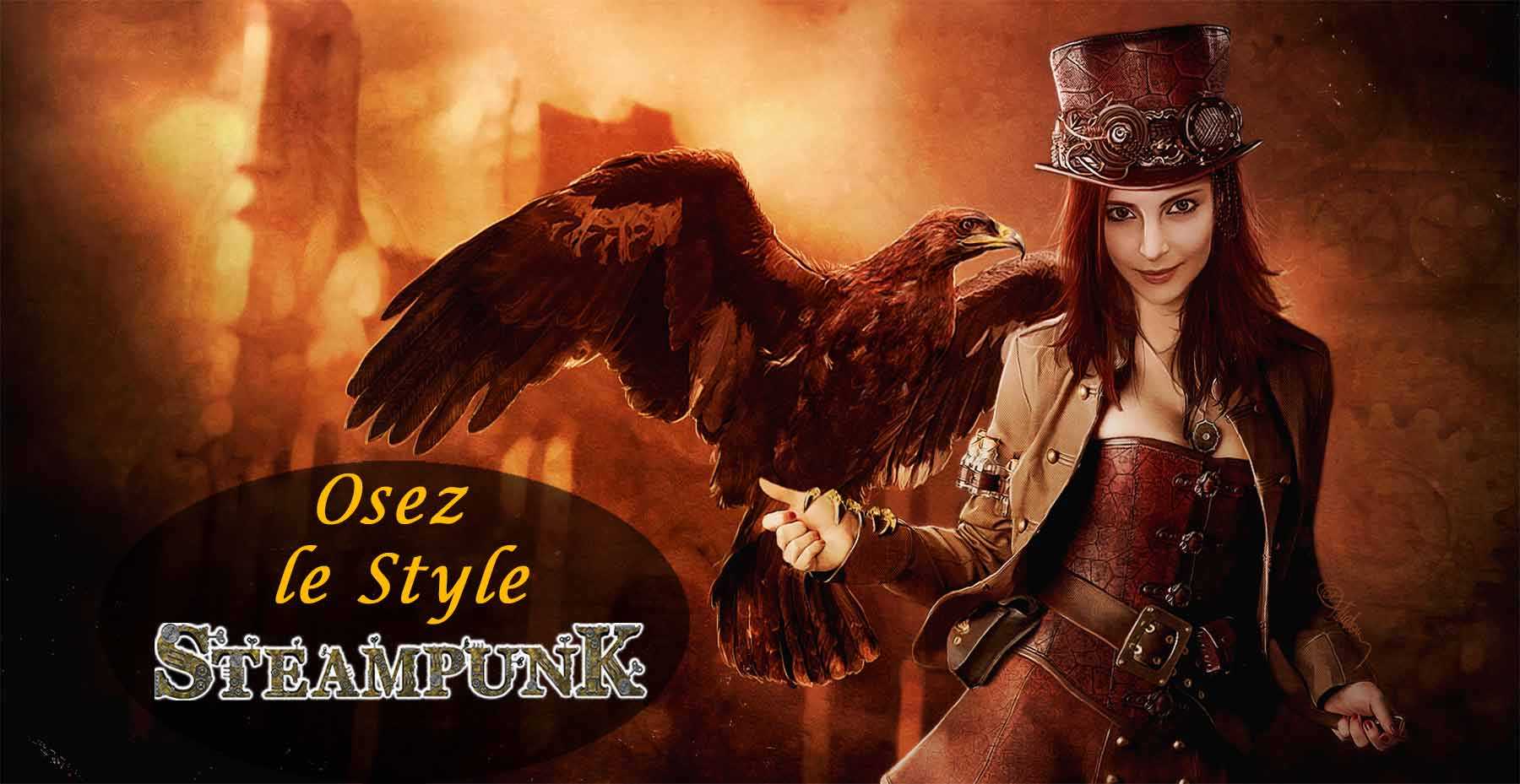
Explore our complete steampunk universe to celebrate Halloween in style, and discover our steampunk masks, our corsets and our accessories to create a costume worthy of the Victorian era!
For remember, dear readers: in the steampunk universe, as in the history of Halloween, we do not merely celebrate ancient traditions — we forge mechanical legends that transcend time!
Sources and References
- Kelley, Ruth Edna. "The Book of Halloween" (1919)
- Frazer, James George. "The Golden Bough: A Study in Magic and Religion" (1890)
- Irving, Washington. "The Legend of Sleepy Hollow" (1820)
- Historical archives of Irish immigration to the United States
- Documentation on medieval British traditions
- Contemporary studies on the evolution of popular celebrations
Eugénie Vaporette
Curatorial consultant in steampunk aesthetics
Graduate in the history of Victorian technologies