



We are going to introduce you to the science fiction universes neighboring the Steampunk Style in just a few minutes — including cyberpunk, which made headlines with the CD Projekt Red game recently released, Cyberpunk 2077. Do these genres share common gears? Follow the meanders of my pen to bridge apparently distant genres that are in fact very close in their communities, their culture, and their revolutionary ideas. Discover styles and subgenres that few know, some even more extraordinary than cyberpunk and its Night City.
Cyberpunk Style and Its Dark Pessimism
Origins of the Cyberpunk Movement
This subgenre of science fiction, like a malfunctioning automaton, grew popular in the 1980s thanks to visionaries such as William Gibson, Bruce Sterling, and Roger Zelazny. Their cyberpunk novels unveil dystopian universes where populations — as depicted by Harlan Ellison or Philip Jose Farmer — struggle to survive in a dehumanized world steeped in ambient pessimism.
These subcultures even managed to influence popular culture, with films like Blade Runner, inspired by Philip K. Dick's visionary novel. The cyberpunk movement and cyberpunk literature represent far more than a passing trend in the United States. Mozart in Mirror Shades, one of the first cyberpunk novels published, was even compared to a mechanical symphony by Isaac Asimov.
However, cyberpunk is also criticized for its cynicism and its pessimistic vision of the future. Some voices speak out against its lack of hope — a stark contrast to the creative optimism we cherish in the steampunk universe.
The cyberpunk style is defined by a dark, dystopian vision of the future. Technology reaches a point where it has merged with humanity, augmenting it but also enslaving it through ideology and cyberspace. In some respects, this dystopian world seems dangerously close to our own. With video games like Cyberpunk 2077, isn't the resemblance unsettling?
The Aesthetics and Design of Cyberpunk
The cyberpunk world resembles a seized machine: a high-tech city rotted by violence and pollution, overpopulation and the oppression of corporations that have supplanted nation-states. These mega-corporations reign supreme while a handful of anti-heroes try to survive in their own way.
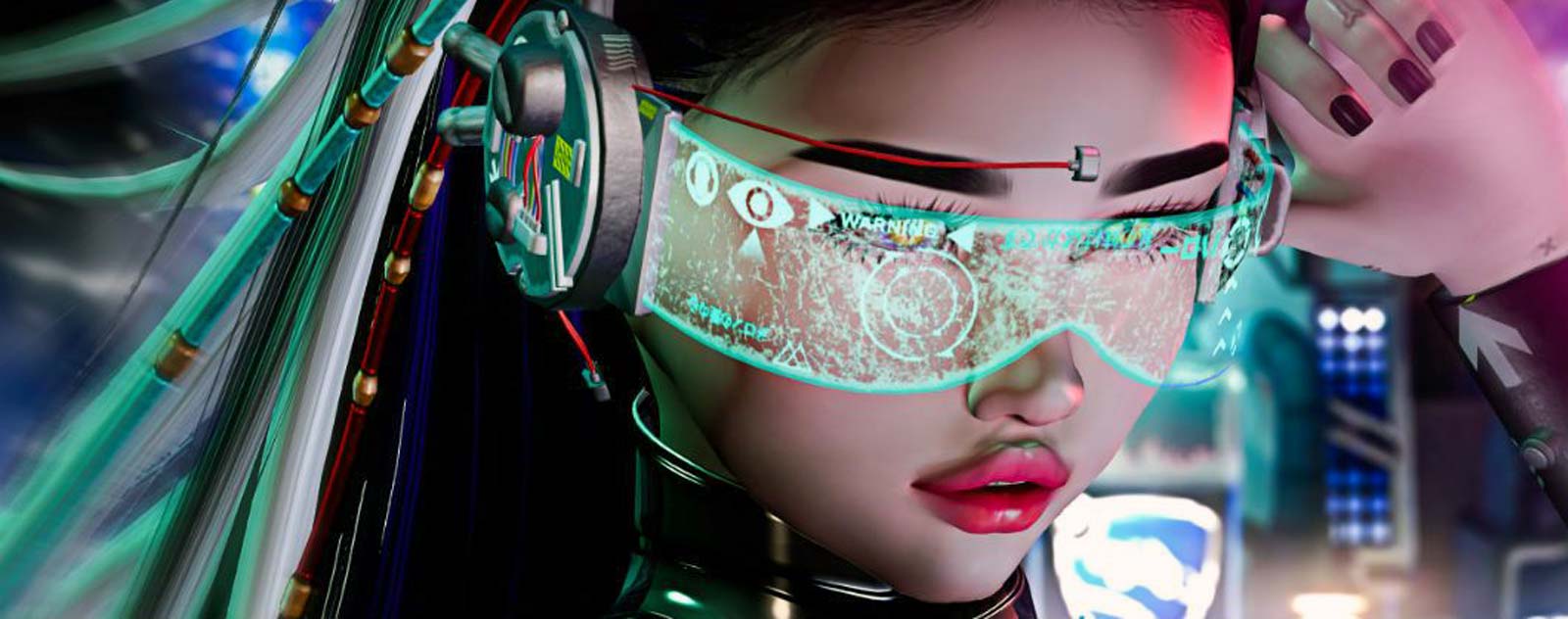
On the streets, the matrix (an ultra-connected internet), implants, AI-driven robots, ghettos, gangs, black leather clothing, neon lights, and digital combat hold sway. This vision, now so pervasive in books and films, has become our default way of thinking about cyberpunk — even as we already live many of its aspects.
Though it was published two years after Blade Runner and is not recognized as the first cyberpunk novel, Neuromancer by William Gibson remains arguably the finest example of retro cyberpunk style, halfway between noir fiction and futuristic dystopia.
Only The Matrix manages to be even darker, where the machine has decided to use us as batteries and created an illusion of virtual society. The most ironic part? The machines do not wish us harm — they keep us in the matrix for the sake of peace and function, humanity being incapable of its own survival in reality.
The cyberpunk style has evolved, becoming a rich melting pot encompassing:
- Other cyberpunk films: Blade Runner 2049 by Denis Villeneuve, Johnny Mnemonic, Brazil, Total Recall, Ready Player One (cyberspace and pop culture)
- TV series: Black Mirror, Altered Carbon on Netflix
- Masamune Shirow's anime such as Ghost in the Shell, Avalon, and Akira. The revival comes through manga and a Japanese avant-garde movement
- Comics, with Transmetropolitan by Warren Ellis and Darick Robertson
- Video games, including Cyberpunk 2077 and Shin Megami Tensei II
- Music, with Billy Idol's cyberpunk album
One will note that Keanu Reeves has a marked tendency to appear in cyberpunk films and video games...

Is There Such a Thing as Cyberpunk Fashion?
Clearly, no. Dear readers, unlike our rich authentic steampunk wardrobe, cyberpunk fashion remains a blend of punk and gothic, seasoned with a futuristic touch that lends it a modern edge.
If you are looking for cyberpunk clothing, expect black garments, combat boots, metal accessories, and radical hairstyles. Cyborg looks — featuring futuristic sunglasses, patterns, and colors reminiscent of computing — are also popular.
Cyberpunk fashion must not be confused with the cultural movement itself. It is first and foremost a science fiction subgenre with a literary and cinematic tradition that critiques technological excesses and corporate wrongdoing.
No Future for Cyberpunk?
And while the analogy between the cyberpunk genre and our own era may be jarring, we are still far from the extremely dark universe of Ridley Scott's film — the benchmark for cyberpunk at the cinema. Curiously, Blade Runner is far more cyberpunk than the book it is based on, "Do Androids Dream of Electric Sheep?" by Philip K. Dick.
Little by little, cyberpunk dried up and has almost vanished today. This subculture needs to reinvent itself and distance itself from our present, which has caught up with science fiction in terms of technological advances and social regression. Our present is even becoming darker in many respects. The inverse of the retrofuturist style...
Reverse the Steam of Cyberpunk and You Have Steampunk

So what do cyberpunk and steampunk have in common, beyond that suffix? Not much in terms of era, aesthetics, or themes! Certainly, technology remains at the heart of both genres: cyberpunk explores the future that could be, while steampunk reveals the past that might have been. But beyond that, the term was poorly chosen by K.W. Jeter. You no doubt know the story — he simply wanted to make an impression and distinguish the genres.

The strength of steampunk against cyberpunk lies in its timeless uchronia, though it is marked as taking place in the Victorian era. This makes it easy to play with the codes of the Industrial Revolution — steam and gears — and transplant them into other universes. Another strength? Magic and the fantastic integrate naturally into steampunk! Everyone instinctively understands that making these marvelous contraptions work would have been impossible in the actual Victorian era (automatons, computers, etc.). Fantastical and supernatural elements slot effortlessly into retrofuturist science fiction.
Uchronia and Ideology: Common Ground Among Punk Universes
Definition of Uchronia
Uchronia, dear steampunks, constitutes this narrative method that proposes an alternative perspective on history, imagining what would have happened had certain key events unfolded differently. In uchronia, authors rewrite history by modifying historical facts, famous figures, or events to propose an alternative reality to our own. This form of fiction allows us to explore the consequences of different choices on our present and future, while offering a compelling perspective on our own history. Uchronia is therefore a tool for reflecting on history and the impact of our choices on our reality.
Ideologies: The Heart of Alternative Movements
These cultural movements share the common feature of proposing alternative universes that invite reflection on our own reality. By proposing dystopias or retrofuturisms, they question our relationship to technology and history. They show how our current choices can impact our future and offer visions of the world that can be either alarming or inspiring.
Another common thread is the community and ideological soil from which these dystopian universes grew. It is the rejection of conformity, of the consumerist world, and of a dark vision of the future. Where cyberpunk warns that the future could be dehumanized and throws its hands up, steampunk aims to be a little more optimistic and engaged. It is possible to make things yourself, to recycle, to reuse, and for each of us to be responsible for our own future, without waiting to be spoon-fed — exactly as in our DIY steampunk projects!
Now let us look at the neighboring universes that are for the most part subgenres of cyberpunk or steampunk.
Dieselpunk

This 21st-century offspring, born around 2001 — though various films and books had played with the idea for decades — constitutes a fascinating mechanical evolution! The simplest way to describe dieselpunk is steampunk where the technology of the Industrial Revolution is replaced by the combustion engine. The technology is more recent and the aesthetic draws from the late 1930s through the 1950s. Instead of our giant wooden and brass airships, imagine giant steel zeppelins!
The reference period is World War II, with all the clichés of the era sprinkled with the fantastic. It involves enormous improbable machines and diesel engines belching black smoke. Dieselpunk is far more present in cinema and television than in books — as in Sky Captain and the World of Tomorrow or The Rocketeer. There is, however, a growing contingent of novels, the best known of which is probably Scott Westerfeld's Leviathan series.
Dieselpunk ends where peacetime and the Cold War take over...
Atompunk

Yes, dear readers, there is a genre for practically every decade of the 20th century! Atompunk takes the modern mid-century style, the nuclear revolution, and the space age of Sputnik and blends them all together to create something quite sleek and shiny. Offbeat humor is more than welcome given this perilous period, which is sometimes post-apocalyptic with everything laid to waste.
The Fallout video game series, animated series like Futurama, The Jetsons, and the film The Incredibles capture the genre well. Orbit City from The Jetsons cartoon is a prime example. Atompunk has its own punk elements, unfolding in the context of McCarthyism, the civil rights movement, and the Vietnam War. Technology was advancing rapidly and society struggled to keep pace — a kind of cyberpunk without the transhumanism angle, in a sense. The genre has fertile ground for reimagining these social struggles.

One wonders whether atompunk is synonymous with raypunk and teslapunk. The main difference is that these generally do not include nuclear energy, but share the same aesthetic. It is no surprise that they have been popular in recent years. There is also a genuine renaissance of mid-century modernist architecture and design, so perhaps we shall see atompunk's popularity grow?
Speaking of colorful, vibrant universes, here is another...
Dreampunk

Here is a rather unclassifiable style that takes root in the imagination and the world of dreams! The reference point remains, as with any Victorian-era steampunk derivative, the very well-known Alice in Wonderland by Lewis Carroll. Another classic comes to mind: The Wizard of Oz by L.F. Baum. Dreampunk is therefore bewildering, even unhinged — one dresses up as the Mad Hatter or Tinker Bell. Accessories come from magical universes and ultimately the only limit is our imagination.

These are colorful and surrealist universes peopled with mystical creatures — unicorns and dragons are well represented. Over time they drifted away from magic and closer to technology, often mechanical. A kind of steampunk fused with the fairy world. A more recent example of these alternative worlds is Arthur and the Minimoys, or the adaptations of Philip K. Dick's novels (Total Recall, Minority Report, or Blade Runner — well, well). These works share a common imaginative quality: the conflict between dream and reality... Do replicants have an imagination? Am I truly "me," or someone else's memories?
Biopunk

Biopunk is the biological cousin of cyberpunk. They often unfold in very similar periods, or biopunk is the successor to cyberpunk. Metal and technology are replaced by biological hacking, genetic modification, and organic enhancement. Biopunk pushes existential questions further than cyberpunk. Technologies such as genetic tracking, designer babies, and mass cloning are recurring themes. Welcome to Gattaca.
Cyberpunk often concerns itself with man versus machine, but biopunk addresses themes of man versus the post-human. The fundamental question biopunk poses is: where does the human being end? When neither genre is taken to extremes, you can find biopunk and cyberpunk elements within the same setting.

Yet many authors imagine the cybernetic technology of cyberpunk as the more primitive cousin of biopunk's bio-engineering. Jurassic Park and Activision's game Prototype both embrace the implications of biopunk bio-engineering, though not its aesthetic. Netflix's short-film anthology Love Death & Robots is a recent example that encompasses both technology and aesthetics.
Western Punk or Cattlepunk

Different names for the same thing — the little-known category of science fiction dedicated to a retrofuturist western, a Wild West that never existed. Many examples in this genre are underground, some genuine gems and others a little odd. If you would like the Lone Ranger equipped with improbable gadgets, cattlepunk may be the genre for you.
The best-known example is Wild Wild West — technically the first steampunk TV series. Simply imagine an alternative Wild West with advanced technology based on steam engines. Other examples of films in the genre include Cowboys & Aliens and of course the enormous Back to the Future III.
That covers this rich collection of universes, each competing in ingenuity and inventive concepts. We have skipped the most obscure ones — sometimes more anecdotal — which we shall mention only briefly.
The "-punk" Subgenres

- Clockpunk: a steampunk set at the origins of mechanics, such as the Renaissance, fond of anachronistic mechanisms. Leonardo da Vinci often features, as in the TV series Da Vinci's Demons or the game Assassin's Creed 2.
- Decopunk: a refined, glossy, very Art Deco version of steampunk. Fantastical films with the aesthetics of the 1930s are representative, such as The Shadow (1994).
- Nanopunk: a version of cyberpunk close to biopunk, where the central theme is nanobiology.
- Raypunk: very close to, or even overlapping with, atompunk. This genre focuses on space and takes little interest in atomic energy. Buck Rogers and Flash Gordon are highly representative.
- Rococopunk: close to clockpunk and therefore to steampunk, with the aesthetic of the 18th-century French rococo period. Widely used especially in fashion by Vivienne Westwood.
- Solarpunk: a cyberpunk subgenre that counters its parent model. The future here is optimistic. Themes center on ecology and social inequality addressed through technology.
- Steelpunk: a modified dieselpunk where technology would be closer to the 1980s. The setting is often post-apocalyptic, as in Snowpiercer or Terminator.
- Stonepunk: an anachronistic prehistory like The Flintstones, serving as a pretext for satire of the present day combined with offbeat humor.
- Teslapunk: named after the famous inventor. A science fiction where magnetism and electrical energy sit at the center of the narrative and visuals.
I hope, dear steampunks, that you have discovered new territories beyond the cyberpunk style and the game Cyberpunk 2077. All that remains is to explore these fascinating universes, each one a unique gear in the great machinery of human imagination! These cultural movements propose alternative worlds that invite reflection on our own reality, creating a community of free spirits united by the rejection of conformity.
To complete your wardrobe for these different styles, explore our cosplay collection and our authentic steampunk accessories. Also discover our selection of steampunk goggles and steampunk watches to perfect your look.
Thank you for reading, and see you soon, steampunks, for another article on the intoxicating world of steampunk!
Sources and References
- Gibson, William. "Neuromancer" (1984) — founding work of cyberpunk
- Sterling, Bruce. "Mirrorshades" (1986) — seminal cyberpunk anthology
- Jeter, K.W. — creator of the term "steampunk"
- Dick, Philip K. "Do Androids Dream of Electric Sheep?" (1968)
- Archives of alternative science fiction and punk movements
- Comparative analyses of retrofuturist genres
Eugénie Vaporette
Curator-consultant in steampunk aesthetics
Specialist in uchronias and alternative cultures