


The novel Oliver Twist, published in serial form between February 1837 and June 1839, is one of the masterworks of Victorian literature. This social chronicle depicts with mechanical precision the striking contrasts of the Victorian era, when the industrial revolution was transforming London into a true metropolis with complex social gears. For us steampunk enthusiasts, this work represents far more than a simple novel: it is an open window onto the universe that inspires our retro-futuristic aesthetic!
What is Oliver Twist?
Oliver Twist is a melodramatic novel by Charles Dickens, published between 1837 and 1839, which tells the story of an orphan in Victorian London. This foundational work of English literature critiques the social institutions of the era, notably workhouses and the Poor Laws, while offering a striking portrait of British industrial society that today inspires the steampunk universe.
The Story of Oliver Twist in the Gears of Victorian London
Oliver is born in a workhouse where his mother dies just after giving birth, like a mechanism broken by social harshness. Frail and left to fend for himself, he grows up in a system of cruel workhouses that characterized Victorian England. At nine years old, starving and desperate, he dares to ask for an extra helping of food — a revolutionary gesture for which he is punished by the workhouse board of directors. This emblematic scene reveals the dysfunctions of the British social machinery under the reign of Queen Victoria.

Placed as an apprentice with Mr Sowerberry, an undertaker, Oliver endures the humiliations of Noah Claypole, who insults the memory of his mother. In a fit of rage, the young boy rebels — like a gear refusing to turn in the direction imposed — and decides to run away to London. This escape marks the beginning of an odyssey through the darkest quarters of the British capital, where the industrial revolution was creating as much wealth as misery.
In the misty alleyways of the metropolis, Oliver meets the Artful Dodger, who introduces him to Fagin's gang, a manipulative fence who trains young pickpockets. This underground London, with its criminals and exploited orphans, represents the dark underside of Victorian prosperity — exactly the type of setting that fuels our most compelling steampunk stories!
The Social Contrasts of the Victorian Era
The genius of Dickens lies in his ability to depict the striking contrasts of Victorian society. Oliver alternates between the criminal underworld and bourgeois homes, such as Mr Brownlow who temporarily takes him in with kindness. These oscillations reflect the social structure of the Victorian era, where industrial wealth and extreme poverty coexisted like a mechanism with disjointed gears. Private charity, embodied by Mr Brownlow and the Maylies, is set against the failure of official institutions — a theme that deeply resonates in our steampunk imagination.
Nancy, the companion of the brutal Bill Sikes, represents a tragic figure of compassion in this merciless world. Despite her life in crime, she protects Oliver and tries to save him, ultimately paying for this kindness with her life. These characters embody human values resisting the relentless gears of a society undergoing industrial transformation.
Charles Dickens and Victorian Social Critique

To write Oliver Twist, Charles Dickens drew inspiration from his own experience and that of Robert Blincoe, whose Memoirs described the horrors of child labor. Dickens himself knew poverty when his father was imprisoned for debt, forcing him to work from adolescence. This period profoundly marked the author, fueling his scathing critique of Victorian social institutions.
The novel appears just after the adoption of the New Poor Laws in 1834, legislation supposedly designed to improve the lot of the destitute but which, in reality, worsened their living conditions. The workhouses, where the rights of the poor were trampled and their labor exploited, functioned like true machines for grinding down the most vulnerable. Dickens denounces this Victorian capitalist individualism that claimed society would run harmoniously if everyone looked after their own interests — a vision he masterfully dismantles through his narrative.
London in the Age of the Industrial Revolution
The Victorian London of Oliver Twist was a metropolis in full transformation, having become the most populous city in the world thanks to the industrial revolution. Steam engines, new factories and the railway were revolutionizing the British economy, but also creating unprecedented urban misery. This duality particularly fascinates steampunk creators, who reinvent this era by imagining alternative technologies and Victorian alternate histories.
Dickens offers a bleak but realistic picture of the living conditions of children of his time. The streets flooded with mud and sewage, the air polluted by factory soot, the crime-ridden slums teeming with criminals — all these elements constitute the raw material of our retro-futuristic aesthetic. Dickens's London, with its contrasts between opulence and misery, directly inspires the atmosphere of many contemporary steampunk works.
Oliver Twist as a Source of Steampunk Inspiration

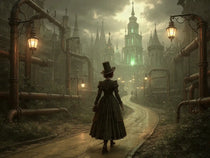
The universe of Oliver Twist resonates deeply with steampunk aesthetics. This pivotal period, when steam revolutionized the world, constitutes the very foundation of our retro-futuristic movement. Dickens's descriptions — misty alleyways lit by gas lamps, workshops filled with gears, the contrasts between wealthy homes and sordid slums — feed our creative imagination.
Some modern theatrical adaptations, such as that of the Secret Theatre in 2013, have given an explicitly steampunk dimension to Oliver Twist. The costumes incorporate steampunk goggles, transformed into a metaphor for time travel, and the staging incorporates elements of Victorian-futurist design. This reinterpretation demonstrates the natural kinship between Dickens's work and our contemporary aesthetic.
The Influence on Steampunk Decoration and Design
The Victorian atmosphere of Oliver Twist inspires our steampunk interior decoration choices. The descriptions of London interiors — from the austere workhouses to the bourgeois salons adorned with marble fireplaces and decorative moldings — guide our creations. The shops of Mr Brownlow, Fagin's dark lairs, the Maylies' country home: each Dickensian setting offers leads for recreating an authentic Victorian atmosphere.
The period objects evoked in the novel — gas lamps, mechanical clocks, mahogany and walnut furniture, Victorian jewelry — constitute the visual vocabulary of steampunk. By integrating these elements into our interiors, we pay homage to the era that inspires our movement. Victorian-style decorations allow us to recreate the atmosphere of Dickens's novels while adding our own retro-futuristic touch.
The Universal Themes of Oliver Twist

Beyond its historical context, Oliver Twist explores universal themes that still resonate today. The struggle between kindness and cruelty, embodied in the opposition between the benevolent characters (Mr Brownlow, Nancy, the Maylies) and the figures of oppression (Fagin, Sikes, the workhouse administrators), forms the moral heart of the narrative. Oliver himself, despite his ordeals, preserves his innocence — like a precious mechanism resisting the destructive gears of society.
The city-country duality also structures the novel. London represents vice, crime and the corruption of the industrial era, while the countryside, where the Maylies reside, symbolizes virtue and peace. This opposition reflects Victorian anxieties in the face of rampant urbanization — concerns that fuel our own reflections on technology and society in the steampunk universe.
The Legacy of Oliver Twist
Dickens's novel continues to be adapted in various forms: musicals, films, television series, stage plays and even steampunk miniatures for collectors. This longevity testifies to the universal power of the story and its place in the collective imagination. For lovers of Victorian literature, Oliver Twist remains an essential gateway into this fascinating era that fuels our steampunk passion.
The iconic characters — young Oliver, the wily Artful Dodger, the sinister Fagin, the tragic Nancy — have become archetypes of world literature. Their psychological complexity and their grounding in the social realities of the Victorian era make them timeless figures who continue to inspire creators and artists, from Victorian fashion designers to steampunk universe designers.
Creating an Oliver Twist Atmosphere at Home
For vaporists wishing to recreate the atmosphere of Victorian London in their home, several key elements are essential. Dark colors — browns, deep greens, bordeaux — evoke Dickensian interiors. Solid wood furniture, with intricate carvings and ornamentation, recalls the furnishings of the bourgeois homes described in the novel. Lamps in a Victorian style, ideally gas-effect or with a design reminiscent of 19th-century lighting, bring that characteristic soft glow.
Accessories play a crucial role: mechanical clocks, brass and copper objects, engravings depicting Victorian London, collections of leather-bound old books. For an authentically steampunk touch, add visible mechanical elements — exposed gears, copper piping, vintage measuring instruments. The result: an interior that could have housed Mr Brownlow while evoking the retro-futuristic imagination!
Victorian Fashion Inspired by Oliver Twist
The Victorian costumes described by Dickens continue to inspire contemporary steampunk fashion. For women, long dresses with corsets and petticoats evoke the elegance of the Victorian era. Lace-up ankle boots, very popular in Oliver Twist's time, remain a steampunk wardrobe staple. Period-inspired jewelry — ornate brooches, cameo necklaces, rings with semi-precious stones — adds the finishing touch.
For the gentlemen, the Victorian three-piece suit remains the foundation, complemented by a frock coat and a top hat. Accessories — leather gloves, pocket watch chains, bow ties — complete the ensemble. By adding steampunk elements (gear goggles, mechanical accessories), one creates a perfect synthesis between Dickens's Victorian elegance and the retro-futuristic aesthetic.
Oliver Twist and Steampunk Literature
The work of Charles Dickens, alongside that of Jules Verne, H.G. Wells and Mary Shelley, constitutes one of the pillars of Victorian literature that inspires steampunk. While Verne and Wells explored future technological possibilities, Dickens meticulously documented the social reality of his era — thus providing the authentic historical context in which our steampunk alternate histories are set.
Dickens's detailed descriptions — London architecture, social hierarchies, emerging technologies, living conditions — offer a precious documentary foundation for any steampunk creator. His work reminds us that behind steam engines and gleaming gears lay complex human realities, social injustices and struggles for survival. This social depth considerably enriches the steampunk universe, preventing it from being reduced to a mere superficial aesthetic.
The Lessons of Oliver Twist for the Steampunk Universe
Oliver Twist teaches us that the Victorian era was not all elegance and mechanical refinement. It was also a period of profound social injustice, where institutions failed to protect the most vulnerable. By integrating this awareness into our steampunk creations, we add depth to our stories and universes. Steampunk heroes, like Oliver, can be ordinary individuals confronted with oppressive systems, yet finding the strength to resist and preserve their humanity.
The novel also reminds us of the importance of individual kindness in the face of collective dysfunction. Mr Brownlow, Nancy and the Maylies represent glimmers of hope in a dark world — archetypes found in many contemporary steampunk narratives. This dialectic between relentless social mechanisms and human resistance considerably enriches our retro-futuristic stories.
Discovering Oliver Twist Today

For vaporists wishing to dive into the world of Oliver Twist, several quality editions exist, including abridged versions ideal for a first reading. The novel, available in various English editions, remains accessible and compelling despite its age. Reading Oliver Twist is an enriching experience for any steampunk enthusiast, offering an authentic immersion into the Victorian era that inspires our movement.
Film and theatrical adaptations also allow one to approach the work from different angles. From the classic musical to contemporary steampunk reinterpretations, each version offers a unique perspective on this timeless masterpiece. Visiting the Charles Dickens Museum in London, located in the author's former home, allows one to discover original manuscripts, rare editions and personal objects that bring Dickens's Victorian world to life.
Oliver Twist as a Gateway to the Victorian Universe
For those discovering the Victorian era through steampunk, Oliver Twist is an excellent entry point. The work combines a compelling plot, memorable characters and precise social documentation — three elements found in the best steampunk creations. After Oliver Twist, one can explore other works by Dickens such as Great Expectations or Bleak House, then discover the author's contemporaries to deepen one's understanding of this fascinating period.
The richness of the Victorian universe extends far beyond what any single novel can offer. The works of Conan Doyle with Sherlock Holmes, the tales of Bram Stoker, the novels of George Eliot — all this literature contributes to building our steampunk imagination. Oliver Twist is one of its cornerstones, offering an uncompromising vision of the society that gave birth to the industrial revolution and, by extension, to our retro-futuristic aesthetic.
There you have it, dear vaporists — why Oliver Twist remains an essential reference for anyone interested in steampunk and its Victorian roots! This young orphan roaming the misty streets of London reminds us that behind our gleaming gears and fanciful steam engines lies a real, complex and fascinating era. By understanding Oliver's story, we enrich our own vision of the steampunk universe and deepen our appreciation of this aesthetic that blends the Victorian past with futuristic imagination.
May your next reading of Oliver Twist be accompanied by a steaming cup of tea, in the soft glow of a Victorian lamp, surrounded by your favorite steampunk accessories! For in Dickens's universe, as in ours, every detail counts in creating an authentic and captivating atmosphere.
Sources and References
- Dickens, Charles. Oliver Twist (1837-1839) - Original editions and translations
- Historical archives of Victorian London and the era of Charles Dickens
- Documentation on the British industrial revolution and the New Poor Laws
- Critical studies on the work of Charles Dickens and its literary impact
- Charles Dickens Museum, London - Collections and archives
- Analyses of steampunk adaptations of Oliver Twist
- Documentation on Victorian influence in contemporary steampunk culture
Eugénie Vaporette
Literary chronicler of the steam age
Specialist in the Victorian influence on steampunk